

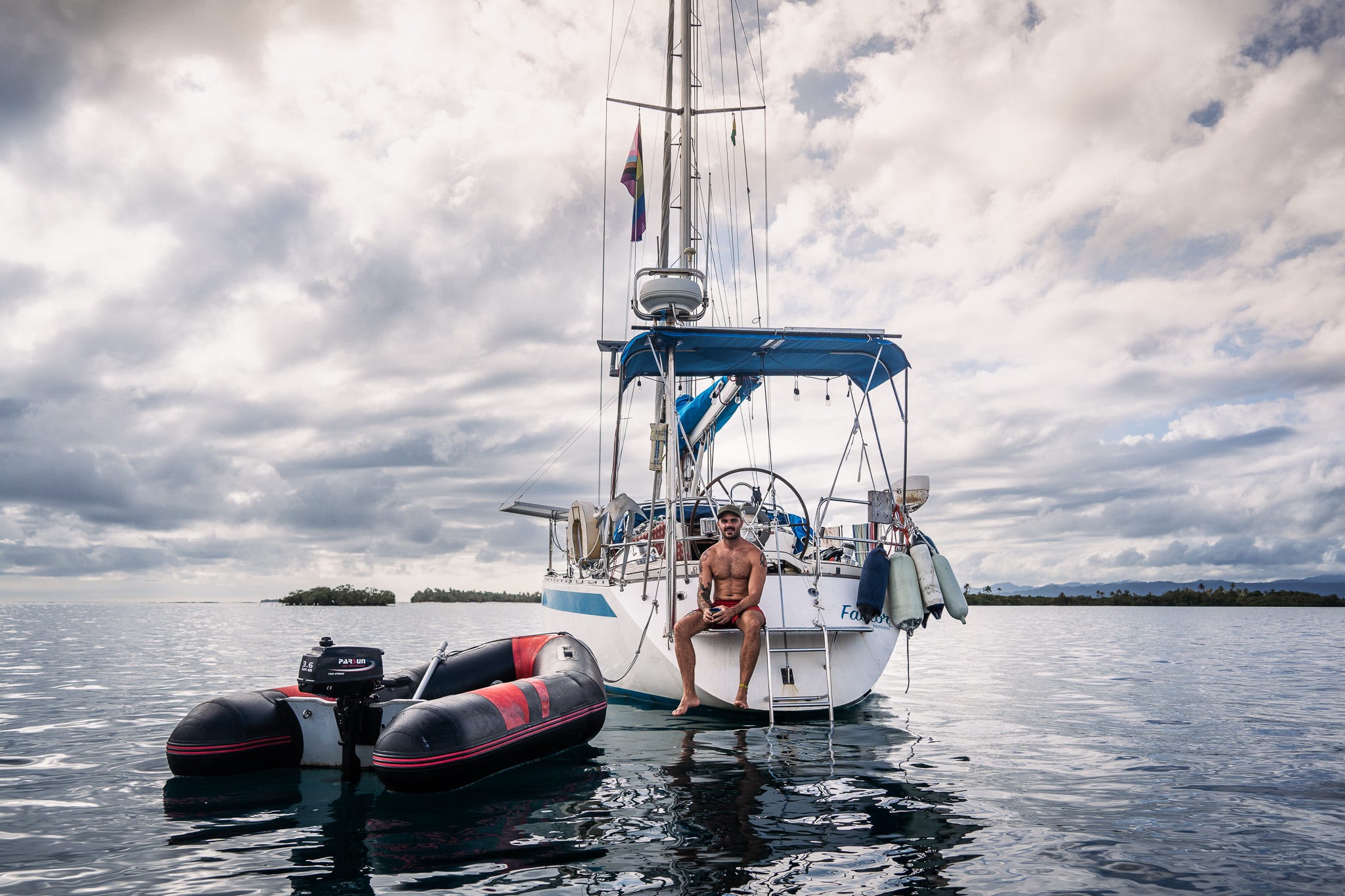
Falkor is anchored in front of the Congreso Central—the central indigenous council of Guna Yala in Porvenir. On board are two representatives from the Congreso who are ceremoniously signing my charter permit, walking me through all the prohibited activities (they span from spearfishing to windsurfing and everything in between).
Up comes what looks like a fisherman in an ulu—a wooden canoe carved out of a big log. “I don’t need fish right now,” I preemptively utter, as the bureaucrats on board interrupt me. “Wait! You have to check out his produce first.”
I look over my railguard, down on the fisherman who proudly signals his catch: two bags of weed, neatly presented next to each other. I politely refuse, and then comes the sales pitch: “I have 500 pounds of marihuana in my home—over on that island right there!” The fisherman explains and points in the direction of the drug den. “I got it from a drug-dealer friend of mine!”
These islands overflow with cheap weed and Colombian cocaine; the latter may be bought for one dollar a gram. Ca. two hundred times cheaper than its street value in Europe and the US. The self-proclaimed pirates on monohulls and catamarans love it.
And so do the fishermen.
The fantasy and the real
In the last few months, I've struck a balance between hustling for cash and enjoying Guna Yala’s dazzling reefs, coconut-island bonanza, castaway pirates, and stereotypically laid-back, content-with-little-material-possession natives.
How do I account for my encounter with Guna Yala without resorting to clichés, when the time I’ve spent here feels like a real-world romantic postcard?
But it’s 2026, and I am neither Jacques Cousteau nor Thor Heyerdahl—I’m a former party queen from Barcelona, and my Guna friends are not Robinson Crusoe’s savages, waiting to teach me how to survive.


Cocodrilo Jones
Mid-July. I’m about to bid the last group of queer expeditioners farewell after nine days of sailing to Guna villages, hiking through the rainforest, and freediving on the reefs.
Gaston, an Argentine diver who has decided to cement his anchor to the ocean bed next to Canirdup, or Green Island to us foreigners, has trained us well. I am finally starting to feel comfortable in the water—like a dolphin, I like to imagine, as I jump in the water and gracefully swim toward the shore, maybe 50 meters from my boat, as the sardines swim.
Halfway across, I unceremoniously pull my boxer shorts off and squeeze out a morning turd. As I turn my head left to observe my log float into the horizon, another log appears some 15 meters away. I focus my gaze—is it not? Oh my God! It is! A BIG FUCKING CROCODILE.
“Auxilio!” I scream at the top of my lungs while my mind replays recent conversations about this apex predator. Gone are my calm demeanours, so carefully staged in front of my guests when I put my captain’s hat on.
The crocodile dives, and for the next 30 seconds, or maybe it’s more, I swim towards shore as my life depends on it. I am not dying today—those aren’t main character vibes and would ruin the plot.
A minute later, as I’m panting my lungs out, naked, on a log, at the shore, Gaston comes running through the woods.
“What happened, hermano?”
“I’m never swimming again.”
Multispecies animosity
Later that day I meet Giovanni, a fisherman from the nearby village of Rio Azucar. I tell him about my brush with death. “If he was hungry, he would have eaten you,” Giovanni says. “Crocodiles don’t eat their prey immediately,” he adds. “They can’t chew, so they kill them, store them, and let their body decompose.”
What a wonderful image to ruminate on at night.
Later that week, news arrives from Rio Azucar: neighbours have killed a big crocodile that had been paying the village frequent visits. Just a month earlier, Pikachu—one of the village dogs—had been eaten to his owners’ dismay.
And for a brief second, the urban environmentalist and multispecies intellectual in me withdraws, and the castaway islander appears: Fuck yes—I’m glad they caught the cunt!
And have you not swam since that day?
Me cago encima otra vez 🤣