


The cavalry has arrived! A few days ago, I got new crew on board Falkor, and weeks of lonely frustration over mounting repairs were finally (or partly) interrupted by friendly support and stress-release through one of late capitalism’s finest inventions: venting.
My own bluntness around the so-called midlife crisis I’ve been navigating for well over a year now was, apparently, what drew the guys in. Probably an example of how like attracting like is not just spiritual whoohoo but sometimes as simple as relating through identification.
“It’s nice to meet you in person,” Adam told me. “And realise that you’re just as messed up as the rest of us…”
Well, he didn’t say it exactly in those words, but that was the gist of it.
In between the exchange of shared miseries, Frank asked the question seething under the surface: “Are you happy, Tomas?” I should be, shouldn’t I? I have been researching happiness for close to a decade, and I’m free as a bird, or perhaps as a dolphin.
But when Adam and Frank probed me, I hesitated. Because what does it mean to be happy?
Feeling good, or practicing a different relationship to feeling?
What do the “experts” say?
Faced with Frank’s question, I was forced to pause and reflect.
Am I happy all the time? Definitely no. Do I sometimes cave in to despair? Definitely yes. Am I content with the life I am living? Depends on when you’re asking.
And then I realised that happiness, for me, is no longer tied to the giggly feeling of upbeat euphoria, but rather, to my capacity to create some distance between who I am and my emotions. That is: to accept the ups and downs without turning them into the sole criteria I evaluate my life by at any given moment.
In other words, a mashup of some of the worlds greatest philosophical traditions.
For, while Buddhism teaches us that ups and downs are part of the impermanence of life and should be approached through non-attachment, the Hindu remind us to acknowledge challenges as part of the process of expansion of the self.

Facing challenges without collapsing
On to the practical application. Take the last couple of weeks—they have been gnarly.
Perhaps without reason (or perhaps rightfully so), I’ve felt close to collapse beneath the weight of my project. Nothing new under the sun: I’ve been here before. And every time I find myself facing challenges with no immediate solution, I’m caught feeling simultaneously lighter and heavier.
Go figure.
Lighter, because I know this feeling by now. The feeling of “WTF do I do now?”, “can someone please come save me?”, and “why can’t this be easier?” And I know that it is fleeting—that if I’m able to keep my cool I’ll sort things out. Non-attachment, eventually.
But also heavier.
Because, despite the certainty that I’ll find a solution (this time too), there’s a part of me that’s just so damn tired of this rodeo. Tired of living in survival mode. The first time something breaks on your boat, it is easy to recur to “positive thinking”. Not so much when it becomes routine.
So what is it then? Do we ever find resolution?

Go with the flow
Earlier this year I experimented with a plant medicine called Xanga during a trip through Yucatán (you can read about my journey here). Xanga is basically smoked DMT, and as the proper little psychonaut I like to tell myself I am, I set an intention to connect with the wisdom of the region.
For the Maya, time is cyclical, not linear—and for the first time in my life, I felt, in my body, what this might mean.
Lady Xanga took me on a spin around the tumble-dryer and dissolved my sense of time, suspending me in a state of circular eternity. The wheel of Samsara, perhaps?
The Maya are not the only ones who understand how energy moves in cycles that take you down and then up and then down again. These shifting states of emotion and mind are necessary phases of our expansion: they imply shifts of perspective and time for integration.
One of the central principles of Taoism is wu wei—the practice of letting things flow naturally, without resistance.
So next time you’re down, ask yourself this: am I stuck or am I in the middle of a process? And can I allow the cycle to unfold without forcing the pace or running from the discomfort?
If you let life unfold, chances are you will get out of the dip, catch your breath, and eventually—dip again (sorry to burst your bubble).
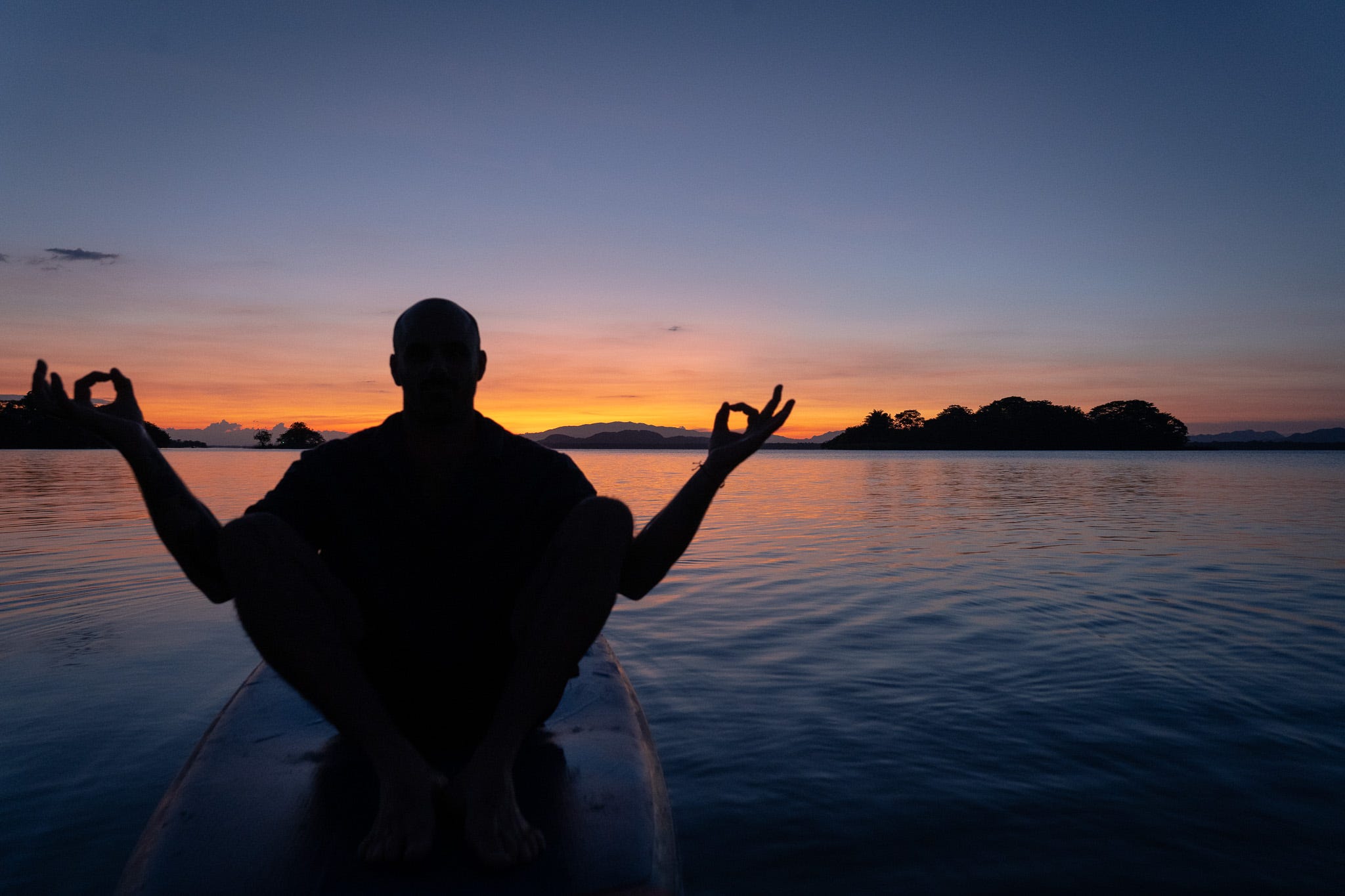
And now, to the conclusion:
From Eastern philosophies to Maya cosmology, different traditions teach us that descent precedes expansion. Experiencing challenging emotions does not mean that you’re doing it wrong. It means that you are “learning a lesson.”
In the West, the early contenders for a theory of happiness that did not rest on the false ideal of perfection were the Ancient Greek.
The Stoics did not see happiness as the absence of difficulty. Rather, they saw it as rooted in an ability to remain grounded when life presents us with friction. For the frugal Epicureans, on the other hand, happiness was found in the appreciation of simple pleasures.
In both schools, the underlying message was clear: don’t expect life to be a fairytale of constant wish fulfilments if you want the real magic to unfold. That is, drop the expectations that warm and fluffy feelings should be the be all end all of your path and appreciate the calm waters in between the storms.
In any case, learning how to navigate life’s difficulties seems like a reasonable prerequisite for a life that feels good. Are you willing to accept the challenge?
Keep saying all the things I need to hear, Mi Capitan! 🫶